
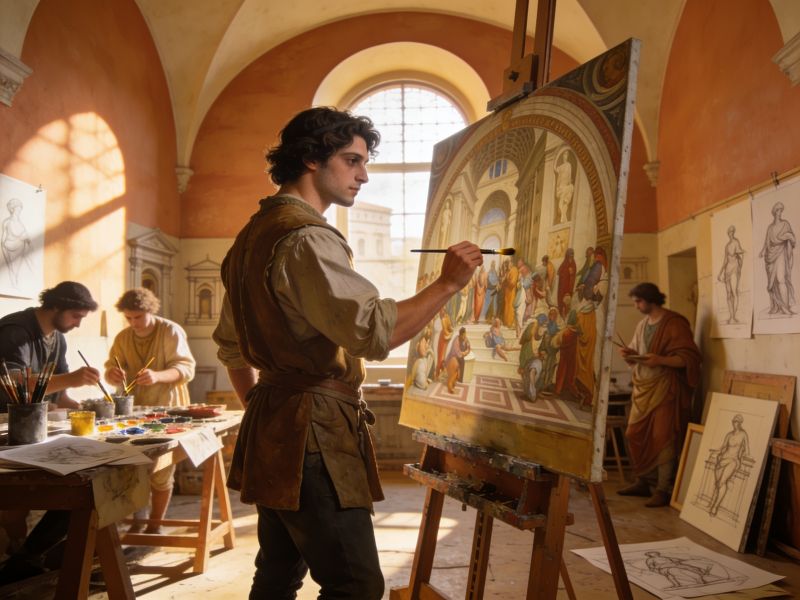
Raffaello Sanzio da Urbino—known simply as Raphael—died in 1520 at 37, yet his influence on Western art remains outsized. His School of Athens in the Vatican Stanza della Segnatura is a masterclass in spatial harmony: figures like Plato and Aristotle anchor a composition that feels both monumental and intimate. Standing before it in 2019, I noticed how the fresco's perspective draws you toward the center, an effect that still feels modern. Raphael's ability to synthesize Leonardo's dynamism and Michelangelo's power into something graceful and clear set a benchmark for centuries.What strikes me about Raphael's career is its arc from youthful lyricism to mature authority. Early works like The Marriage of the Virgin (1504) show a precocious sense of balance, but his Roman years—after 1508—reveal a deeper command of narrative. In the Stanza di Eliodoro, The Expulsion of Heliodorus uses dramatic lighting and movement without sacrificing clarity. That balance became his signature. Critics sometimes call him 'sweet,' but that undersells the intellectual rigor behind each choice. A 2020 exhibition at the Scuderie del Quirinale。marking the 500th anniversary of his death, made this clear: the drawings on display showed endless revisions, proving that effortlessness was hard-won.Raphael's influence extends beyond painting. His workshop system—training assistants like Giulio Romano and Giovanni da Udine—effectively created a brand, spreading his style across Italy and later Europe. The Raphael Cartoons, designs for tapestries in the Sistine Chapel, were sent to Flanders and copied widely. In a sense, Raphael was an early master of reproduction。anticipating the print culture that would follow. I find it telling that his Sistine Madonna (1512–13) became one of the most reproduced images in history。
its two cherubs at the bottom now ubiquitous on mugs and mousepads. That kind of diffusion is rare for any artist.For contemporary viewers, Raphael offers a lesson in restraint. Modern art often prizes disruption, but Raphael's power lies in synthesis—making complexity feel accessible. His Transfiguration, left unfinished at his death, is a case in point: the upper half is serene, the lower half chaos, and the tension between them is unresolved, yet perfect. Art historians still debate his exact role in the late works, but that ambiguity only adds to his fascination. Walking through the Raphael rooms, I overheard a guide say, 'He painted the ideal.' Maybe so, but the ideal here is never cold—it's human。flawed, and endlessly compelling.